

In the early 1930s, while Europe trembled under the weight of economic despair and the dark clouds of nationalism began to gather, a young German named Oskar Speck quietly pushed his folding kayak into the current of the River Danube. It was 1932, and few could imagine that this solitary man, armed with little more than courage, curiosity, and a collapsible boat, would embark on one of the most extraordinary sea journeys ever recorded — a 50,000-kilometer voyage from Germany to Australia that would span seven years, 25 countries, and countless near-death experiences.
Oskar Speck was not an explorer in the traditional sense. Born in Hamburg in 1907, he had no wealthy sponsors, no scientific mission, and no fame to chase. He was simply a man trying to escape the suffocating reality of a collapsing Germany. The Great Depression had destroyed his electrical contracting business, and his homeland was spiraling into the political chaos that would soon give rise to Adolf Hitler.
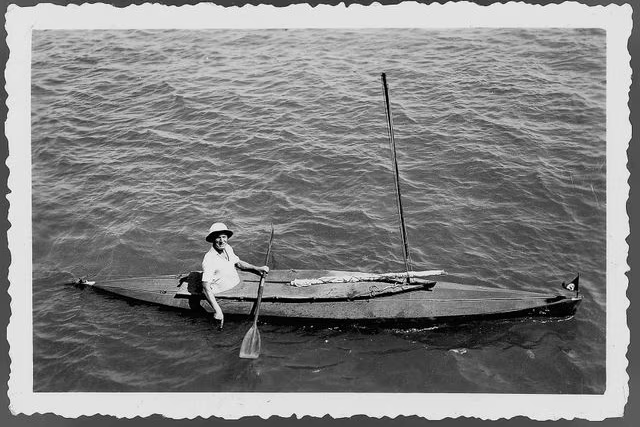
So, he left. Not on a ship, but in a small Faltboot — a folding kayak named Sunnschien. His plan was modest: to paddle down the Danube River to Cyprus, where he hoped to find work in a copper mine. Yet as his boat glided through the waterways of Europe, something changed. The further he traveled, the more he realized he wasn’t just escaping Germany — he was discovering the world, one paddle stroke at a time.

From mountains to oceans, delivered to you. Follow us on Lingkar Bumi WhatsApp Channel.
From the Danube to the Desert
Speck’s route traced a serpentine path through rivers and seas few would dare to cross in a kayak. From the Danube, he reached the Black Sea, then hugged the coastlines of Turkey, Syria, and Lebanon. The journey was both punishing and mesmerizing — he battled fierce winds, blinding heat, and illness, yet every horizon promised a new story.
In the Middle East, Speck paddled past ancient ports that had seen the rise and fall of empires. He met fishermen who had never seen a European traveling alone by kayak. In Egypt, he camped among desert dunes and learned to ration his water with the discipline of a Bedouin. He faced malaria more than once, yet somehow always managed to recover and push forward.
By the time he reached India, his kayak had been patched countless times, his skin was burned dark by the sun, and his body bore the marks of years at sea. Yet Speck was no longer the same man who had left Hamburg. His voyage had turned into something spiritual — an endless test of will, solitude, and resilience.
In Ceylon (now Sri Lanka), he was treated like a celebrity by local journalists who marveled at his audacity. They called him “the man who sails on the edge of reason.” In truth, Speck was not mad, but deeply committed to proving that human endurance could outlast the sea.
He wrote in one of his diaries:
“When you paddle for months, the ocean becomes both friend and enemy. It gives you life, and it tries to take it back. The trick is never to let it see your fear.”

Crossing the Archipelago
Speck’s route eventually brought him into the maze of islands that make up Indonesia, then part of the Dutch East Indies. It was 1938. The world was sliding toward war, though in these remote islands, the tension felt distant. The locals treated him as an oddity — a lone European arriving not by steamer or plane, but by kayak.
He paddled through Sumatra, Java, and Timor, navigating coral reefs, tropical storms, and unpredictable tides. Sharks circled his boat. Once, a wave capsized him in the open sea, and he spent hours clinging to the kayak, praying for calm. Another time, he was forced to camp for weeks on an uninhabited beach while waiting for the monsoon winds to subside.
Everywhere he went, Speck carried with him the same fragile boat — a symbol of his persistence and vulnerability. He mended it with scraps of rubber, tin, and even cloth when no other material was available. In his solitude, he also carried another burden: news of the growing militarism in Europe. Hitler had risen to power. Germany was no longer the country he had left behind.
In September 1939, after seven years of endless paddling, Oskar Speck finally sighted the coast of Australia. The turquoise waters near Darwin shimmered under the tropical sun as he approached, exhausted but victorious. He had survived storms, malaria, and hunger. He had crossed continents under his own strength. He had, against all odds, completed one of the longest kayak journeys in history.
But fate, cruel and ironic, was waiting for him on shore.
Just as Speck set foot on Australian soil, the news arrived: Germany had invaded Poland. World War II had begun. The man who had left Germany to escape chaos now found himself branded as an enemy alien. Within days, Oskar Speck was arrested by Australian authorities and sent to an internment camp as a prisoner of war.
Seven Years Behind Barbed Wire
For the next six years, Speck lived behind fences, his freedom stripped away just as he had reached the edge of his dreams. The irony of his fate haunted him — a man who had conquered the oceans now confined to the desert of South Australia. Yet even there, he refused to be defeated. Fellow inmates remembered him as disciplined, quiet, and endlessly resourceful — traits honed through years of surviving alone at sea.
When the war finally ended in 1945, Speck was released. He chose not to return to Germany, a country still broken by conflict. Instead, he stayed in Australia, where he lived a modest life working in opal mining and occasionally telling fragments of his story to anyone curious enough to ask.
Despite the scale of his achievement, Oskar Speck never received the recognition that other explorers of his era enjoyed. There were no grand medals, no book deals, no documentaries in his lifetime. His story remained buried in the footnotes of maritime history, overshadowed by the global turmoil of the war.
It wasn’t until decades later that historians and adventurers began to rediscover his journey. In the 1990s, his story was revived through exhibitions at the Australian National Maritime Museum, where his original kayak was restored and displayed — a fragile, patched-up vessel that had once carried a man across half the planet.
Recommended article:
A Legacy Carved by Currents
Oskar Speck’s odyssey defies easy explanation. Was it madness, wanderlust, or an act of quiet rebellion against a world losing its humanity? Perhaps it was all three. What is certain is that Speck embodied a kind of courage that feels almost alien today — a willingness to face the unknown with nothing but trust in one’s own endurance.
His journey was not about conquest or glory, but survival and discovery. He had no audience, no compass but the stars, and no destination but the horizon. In a century defined by war and division, Oskar Speck’s story stands as a reminder that exploration can still be an act of peace — a dialogue between man and nature, between the will to move forward and the sea’s infinite patience.
In the end, Oskar Speck lived quietly in Sydney until his death in 1995, at the age of 88. He never sought fame, yet his life continues to inspire paddlers, sailors, and dreamers who see in his story the purest form of adventure — the kind that begins not with a map, but with a decision to leave.
Somewhere along that long blue road between Hamburg and Darwin, he found what so many travelers seek, not a place, but a truth. The sea, he once said, does not reward the strong or punish the weak — it simply reveals who you are. (Sulung Prasetyo)


