

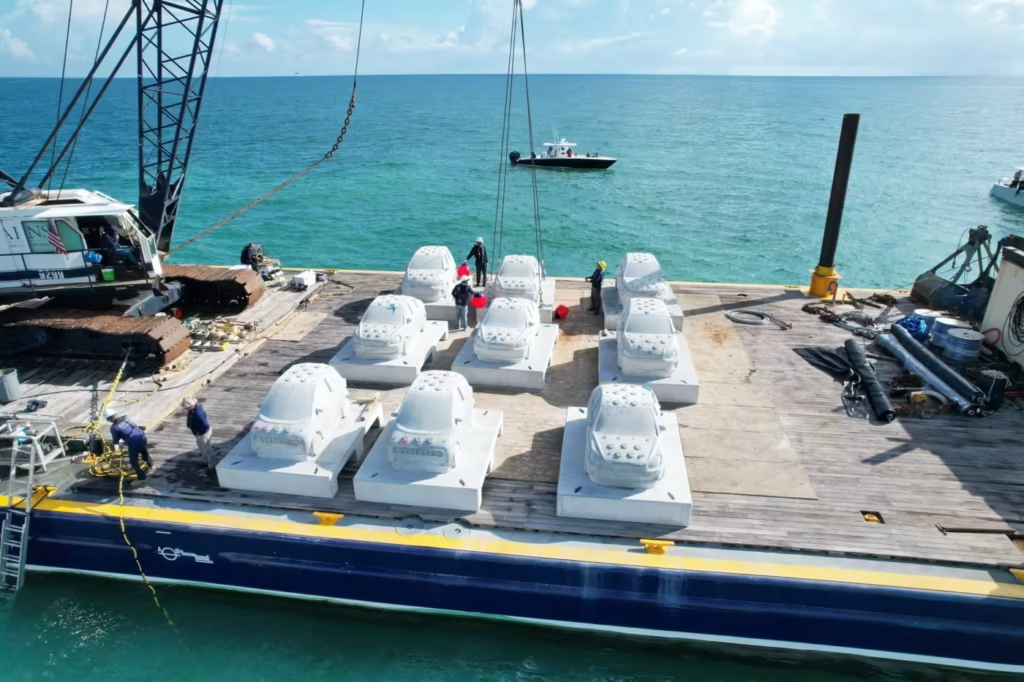
Off the coast of Miami Beach, about twenty feet below the surface of the Atlantic, a line of massive concrete sculptures has begun to transform into a new home for fish, corals, and other marine organisms. At first glance, nothing about these structures looks natural. Some resemble a submerged traffic jam, with life-size cars arranged as if stuck on an underwater highway. But these strange installations are not remnants of a disaster. They are part of an ambitious initiative called The ReefLine, an artificial reef and large-scale underwater art project designed to help slow the decline of Miami’s coastal ecosystems.
Miami has long lived on the edge of danger. Sea-level rise, stronger storms, and accelerating beach erosion place this city on the front lines of the global climate crisis. As scientists warn that parts of the coastline could vanish within decades, artists, marine biologists, and architects have begun searching for solutions that are not only functional but also capable of reshaping the public’s emotional connection to the ocean. From this idea came The ReefLine, led by artist and environmental activist Ximena Caminos, in collaboration with scientists from the University of Miami and a team of marine engineers.
From mountains to oceans, delivered to you. Follow us on Lingkar Bumi WhatsApp Channel.
The project’s first publicly accessible installation is by award-winning artist Leandro Erlich, known for his large-scale optical illusions. Above water, Erlich is famous for transforming buildings into perceived swimming pools and creating playful, mind-bending public spaces. But this time, his work is very different. He created a sunken traffic jam titled “Traffic Jam.” The sculptures are not underwater fantasy. Erlich notes that traffic jams are “a universal metaphor for the contradictions of modern civilization.” Moving this metaphor to the ocean floor, he says, is a way of reminding people that the consequences of human behavior on land inevitably reach the sea.
For scientists, however, ReefLine is far more than an art installation. It represents a promising model for ecological engineering along vulnerable coastlines. Marine biologist Dr. Andrea Neal, a scientific advisor for the project, explained that the porous concrete modules were specifically engineered to support coral growth and mimic the complexity of natural reefs.
In a public statement, she noted, “The textured surfaces and small cavities in these structures are ideal for coral larvae to settle and grow.” Neal emphasizes that in areas like Miami—where natural reefs have been decimated by coral bleaching, rising ocean temperatures, and human activity—artificial reefs can help maintain biodiversity.
Another leading voice, Dr. Diego Lirman, a professor of marine biology at the University of Miami who has spent decades researching Florida’s coral health, provided a broader ecological context. Speaking about ReefLine in a public panel, Lirman said that although artificial reefs cannot fully replace natural ones, projects like this can reduce pressure on remaining habitats.
“We are witnessing major losses in coral reef systems,” he warned. “Restoration efforts must include multiple approaches, including stable artificial structures, to give marine communities a chance to adapt and recover.”
Marine ecologist Dr. Kathryn Mudge, who studies fish dynamics on artificial reefs, has described projects like ReefLine as potential “biodiversity hotspots” when designed with the right shape, size, and placement. However, she also warns of the need for long-term monitoring.
“Artificial reefs must be evaluated regularly,” Mudge said, “so we can understand whether they truly enhance ecological function or simply become underwater attractions.”

That is exactly what is now underway in Miami. Teams of scientists and conservation divers are working together to catalog the species arriving at the structures, track new coral growth, and watch for invasive species that might take advantage of the new habitat. According to Smithsonian reporting, within months of installation, small reef fish began using the structures for shelter, and early colonizers such as algae and sponges started to cover the concrete.
Still, the project has its critics. Some environmental observers caution that artificial reefs must never be seen as an excuse to ignore the root causes of ocean decline—carbon emissions, coastal pollution, and unchecked development. Supporters, however, argue that ReefLine bridges science and public awareness in a way few conservation projects can. Caminos has described ReefLine as “a bridge between science, creativity, and public consciousness.” She believes that art can reach emotional spaces that scientific reports often cannot.
As the sun sets behind the high-rises of Miami Beach, the water’s surface looks calm and quiet. But below, a different world is taking shape—slowly, steadily. Cars draped in algae, concrete pillars teeming with fish, and shifting beams of underwater light create a landscape that may seem surreal, yet serves an unmistakably real purpose. ReefLine is not just underwater art; it is a reminder that the future of coastal cities will depend on how well humans can adapt, collaborate, and respect the most mysterious realm on Earth: the ocean.
If the project succeeds, Miami will not only gain a vast open-air underwater museum but also a living laboratory that helps safeguard the city’s coastal ecosystems. In a rapidly changing world, ReefLine stands as proof that creative solutions—when grounded in science—can offer a small but meaningful hope for a bluer future. (Sulung Prasetyo)


