

The discovery of Rafflesia hasseltii, a rare parasitic plant blooming deep within the Sumatran rainforest, should have marked a moment of shared celebration for the global scientific community. Instead, it ignited widespread criticism directed at the University of Oxford after its public announcement failed to acknowledge the Indonesian researchers central to the expedition. What began as a single social media post has now grown into a broader debate about scientific ethics, inequality in international research, and the longstanding marginalization of Global South scientists.
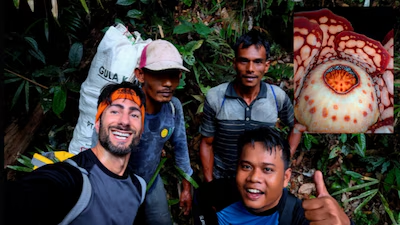
The controversy erupted when the official X (formerly Twitter) account of the Oxford Botanic Garden posted on November 19, 2025, that its deputy director, Chris Thorogood, “was part of a team that trekked into the Sumatran rainforest to discover Rafflesia hasseltii.” The post showcased striking images of the giant flower but did not mention a single Indonesian scientist, guide, or collaborator. This omission struck many Indonesians as a continuation of a troubling pattern in which Western institutions receive credit for discoveries built on the labor and knowledge of local experts.
Public Backlash about Rafflesia Haseltii Discovery
Public backlash quickly intensified. Social media users condemned the omission and urged Oxford to correct what they viewed as an ethically questionable narrative. One user wrote, “Dear @UniofOxford, our Indonesian researchers — Joko Witono, Septi Andriki, and Iswandi — are not NPCs. Please list their names.” Another user expressed frustration in sharper terms: “Write the names of the Indonesian researchers. Colonial mentality!” A third user questioned Oxford’s professionalism by stating, “Hello, can you include the names of the researchers from Indonesia? How can such a major institution fail to appreciate local scientists and not mention them?” These voices captured the anger and disappointment felt by many Indonesians who believed the omission diminished years of work by local experts.
The criticism grew further after former Jakarta governor Anies Baswedan publicly addressed Oxford on X, urging the institution to acknowledge Indonesian researchers as equal contributors. Indonesian media later confirmed that BRIN scientist Joko Witono, conservation activist Septi Andriki, and field specialist Iswandi had all participated significantly in the fieldwork behind the discovery. Their expertise in locating and monitoring Rafflesia species, often in challenging rainforest conditions, was essential to the success of the expedition.
From mountains to oceans, delivered to you. Follow us on Lingkar Bumi WhatsApp Channel.
Indonesian Scientist Clarified
BRIN clarified that the discovery was part of an international collaborative program titled “The First Regional Pan-Phylogeny for Rafflesia,” jointly supported by the Oxford Botanic Garden & Arboretum and BRIN’s RIIM Expedition Program. BRIN emphasized that in upcoming scientific publications, Indonesian researchers would serve as lead or co-lead authors. However, many observers insisted that authorship alone did not resolve the central issue. Oxford’s initial public messaging had already shaped the global narrative in a way that appeared to position the university as the primary driver of the discovery.
“This project is part of our efforts to understand the genetic relationships among Rafflesia species and to ensure their conservation in their natural habitat,” said Joko Ridho Witono, a researcher at BRIN’s Biosystematics and Evolution Research Center. He affirmed that all samples were collected in Indonesia under proper legal protocols, and that no genetic material was transported abroad.
Conservation groups and scientific watchdogs criticized Oxford’s approach as an example of “parachute research,” a term used to describe situations in which foreign institutions conduct studies in biodiverse countries but disproportionately claim credit. The phrase “international group of scientists,” used in Oxford’s post without naming any Indonesian collaborators, was widely viewed as reinforcing structural inequalities in global science.
The Indonesian scientific community stressed that recognition is far more than a symbolic gesture. Proper credit affects academic careers, funding opportunities, national scientific reputation, and the visibility of local ecological knowledge. When researchers from major institutions fail to name their collaborators, it undermines trust and perpetuates the global imbalance in conservation research.
While BRIN reiterated that the overall collaboration with Oxford remained strong, the agency acknowledged that the social media post had caused misunderstanding and misrepresentation. Despite the growing backlash, the University of Oxford has not issued any official public comment, clarification, or apology regarding the controversy. The silence has further fueled criticism, with many calling on Oxford to address concerns transparently and acknowledge the contributions of Indonesian researchers.
Rafflesia hasseltii is considered one of the rarest flowers in the world, found only in limited forest areas of Sumatra, Indonesia. Its life cycle is highly unusual: the plant spends most of its existence hidden as a parasite inside a host vine from the genus Tetrastigma, emerging only briefly to bloom. This bloom can take years to form and lasts no more than a few days before decaying, making scientific observation extremely difficult. Habitat loss, forest fragmentation, and human encroachment have pushed many Rafflesia populations to the brink, with some local populations disappearing entirely before they are formally documented. (Sulung Prasetyo)


